La Palma has much more to offer than sun and sea.
For your excursions, we have compiled hikes, swimming spots, museums, and restaurants. This way, you can explore the island at your own pace.
For your excursions, we have compiled hikes, swimming spots, museums, and restaurants. This way, you can explore the island at your own pace.
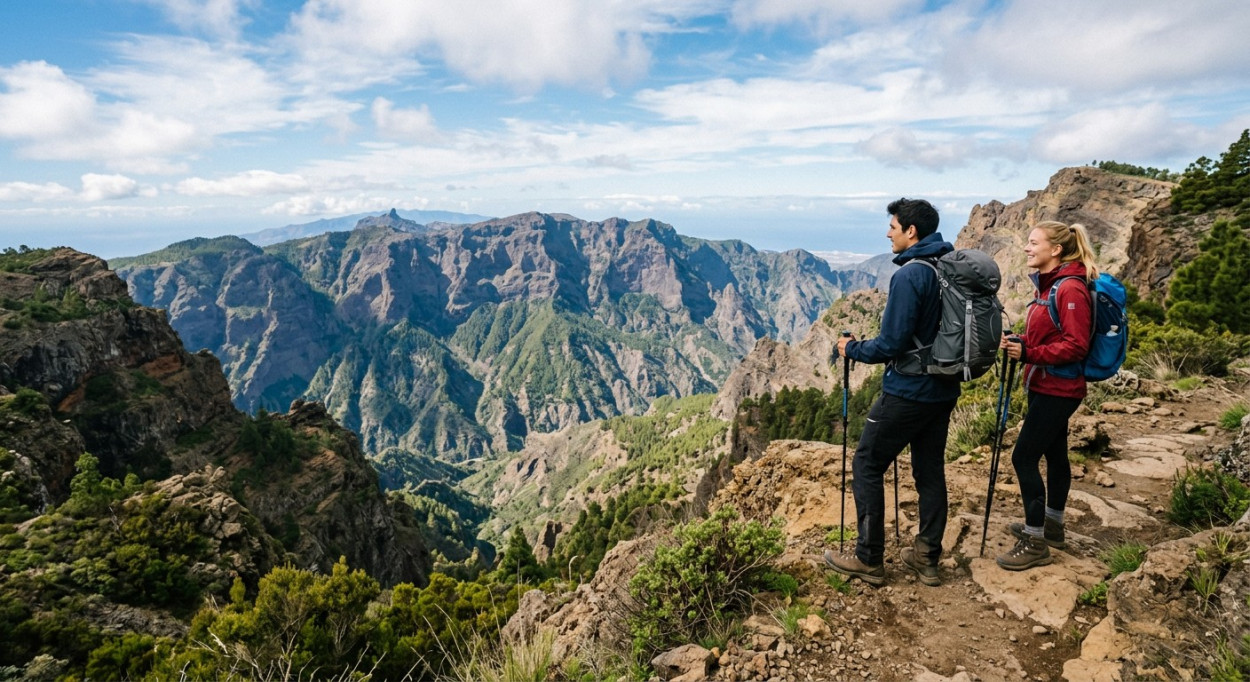
The local hiking trails are often marked green-white as SL. They are usually shorter than ten kilometers; however, you should check the length and difficulty before each tour.
Bring sturdy shoes, enough water, and a light jacket. Especially in the mountains, the weather can change quickly.
With a rental car, you can reach many starting points flexibly. Inform yourself about access, parking options, and the condition of the trail before the trip.
Loop trail of about 4.5 to 6.5 kilometers; plan for approximately two hours.
The trail leads through a charming cultural landscape, past old dwellings and impressive dragon trees.
Over approximately three kilometers, the easy loop trail offers several viewpoints in the Caldera de Taburiente. Expect to spend about one to one and a half hours.
A walk through the dense laurel forest. For about four kilometers round trip, you should plan one and a half to two hours. It’s best to check which sections are accessible before setting off.
You can find more guided hikes with our hiking partner Graja Tours: https://wandern-auf-la-palma.de/de/
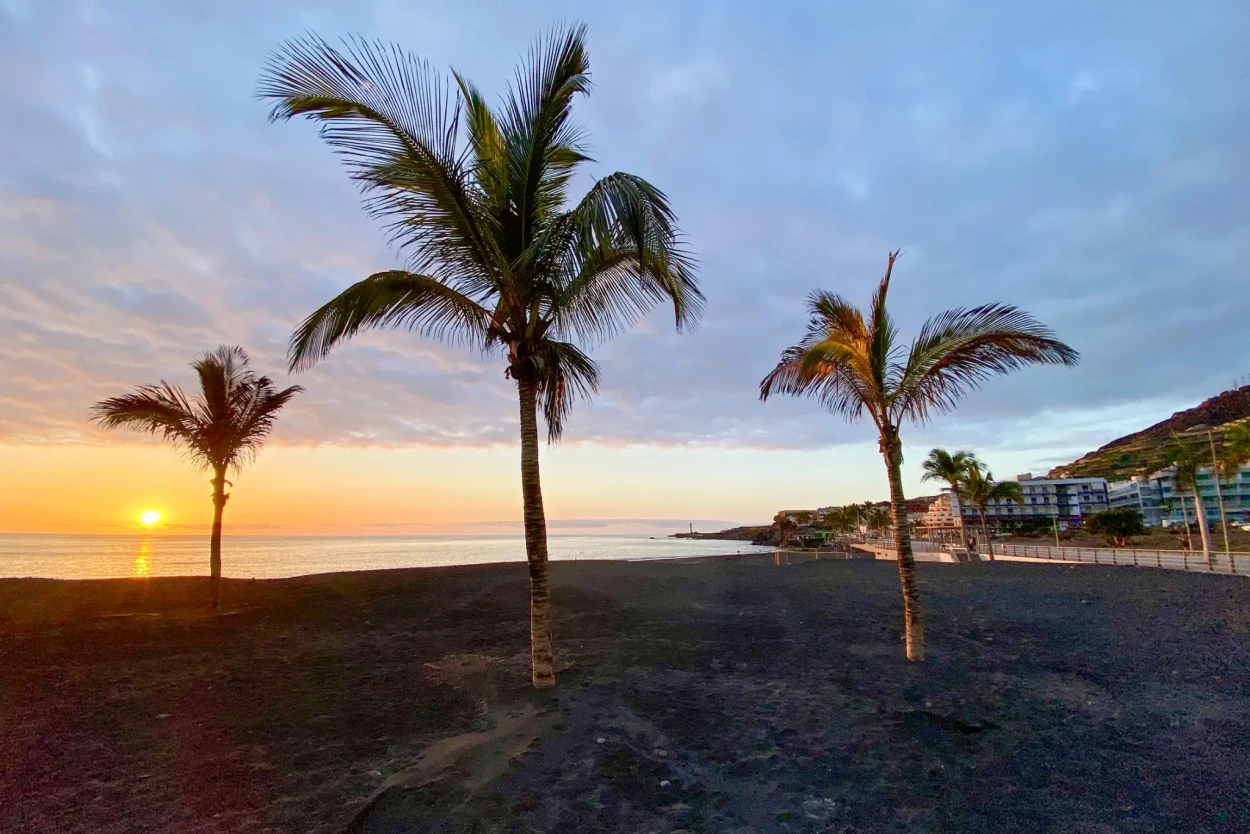
On La Palma, you will find long black sand beaches, small coves, and swimming spots among the rocks. The dark sand owes its color to the volcanic origin of the island. In many places, it is quieter than at the large beaches of Tenerife or Gran Canaria.
The Atlantic still demands attention: Pay attention to the signals from the rescue service and the beach flags. Green signals good bathing conditions, yellow warns to be cautious, and red means you are not allowed to swim.
The eruption of Tajogaite in 2021 changed the west coast. Puerto Naos is accessible again and continues to be monitored for CO₂; the former Playa de los Guirres has been covered by lava. Check the current access points before a trip and pay attention to barriers and signs on site.
Puerto Naos is located on the sunny west side of La Palma and has one of the island's most famous black sand beaches. Olivine crystals give the volcanic sand a greenish shimmer in places. Palm trees provide shade, and the promenade connects the beach with restaurants, terraces, and accommodations. Access is largely barrier-free.
After the Tajogaite eruption, Puerto Naos was closed for a long time due to increased CO₂ levels. The beach is accessible again; please pay attention to the current local notices when visiting.
The Playa del Puerto de Tazacorte is located at the mouth of the Barranco de las Angustias and is one of the longest black sand beaches on the island. A breakwater dampens the current and surf, making the beach particularly popular with families. The promenade, barrier-free access, parking facilities, bus stop, as well as restaurants and cafés are directly in the vicinity. From the beach, one can also observe one of the most beautiful sunsets on La Palma's west coast.
Charco Verde is a bay about 150 meters long south of Puerto Naos, framed by cliffs and banana plantations. Black sand, usually moderate waves, and the sheltered location make it popular with families. The beach is accessible by road and has parking, ramps and walkways, outdoor showers, toilets, and a small kiosk with a terrace. Some services, including public transport, may be seasonal.
Below Las Indias in the southwest of La Palma lie Zamora Grande and Zamora Chica, two black sand coves separated by a rock. Stairs lead down from the parking lot above the cliff to the sea. The sheltered location and volcanic backdrop make La Zamora a popular retreat; surfers also come here when the waves are suitable. As there is no permanent lifeguard and the current and surf can be strong, special caution is advised.
Punta Larga is a bay of about 100 meters long made of black sand in the coastal area of Fuencaliente. Three lava flows that reached the sea formed the small beach, which is now protected by a breakwater. Stairs facilitate entry into the water; parking, bus connections, and dining options are available in the vicinity. The bay is not supervised. Even with usually moderate waves, families should check the current conditions and supervise children near the water.
Playa Echentive, also known as Playa Nueva, was formed in 1971 by the eruption of the Teneguía volcano. The approximately 300-meter-long black beach is located in a young lava landscape near the southern tip and is accessible by car despite its wild character. Natural seawater pools between the rocks offer some protection from the surf. However, the open beach itself is unmonitored, and the Atlantic can be rough; swimming is only advisable under suitable conditions.
Playa del Faro is located below the old and new lighthouses of Fuencaliente, just a few steps from the salt pans and the marine reserve. The small cove consists of black sand and gravel; a protected section is also used by fishing boats. The beach can be well combined with a visit to the lighthouses and salt pans, but has only a few services and no permanent lifeguard. Therefore, wave conditions and local notices should be checked before swimming.
La Salemera is located on the southeast coast of Villa de Mazo in a small, traditional fishing village. Next to the dark beach, there is a large seawater pool protected by coastal rocks, which is particularly popular with families. There are dining options in the vicinity, and the lighthouse shapes the image of the bay. However, wind and Atlantic waves can still be noticeably felt; the conditions in the open sea should not be confused with those of the protected pool.
Los Cancajos is located on the east coast between the airport and Santa Cruz de La Palma. A breakwater made of volcanic rock protects the black sand bay and often provides calmer waters. The diverse underwater landscape makes the beach particularly interesting for snorkeling and diving. Facilities include barrier-free access, parking, bus connections, showers, toilets, as well as the rental of sun loungers and umbrellas. Restaurants, hotels, and apartments are located in the immediate vicinity.
The Playa de Bajamar is located on the coast of Breña Alta, immediately south of Santa Cruz de La Palma between the marina and the natural monument Risco de la Concepción. The approximately 700-meter-long black sand beach is popular with locals year-round. It offers barrier-free access, parking, showers, and toilets; cafés and restaurants are nearby. Due to its location on the east coast, the bay is particularly well-suited for experiencing the sunrise.
The city beach of Santa Cruz de La Palma was opened in April 2017 and brought back the black volcanic sand to the Avenida Marítima, where the historic Caleta del Varadero used to be. Today, the easily accessible family beach offers showers, toilets, sun umbrella rentals, and sports areas for beach volleyball and beach soccer. Windsurfing, kitesurfing, and wingfoiling are also practiced here. Restaurants, shops, and the historic town center are located directly on the other side of the promenade.
The Playa de los Nogales is located below the cliffs of Puntallana and combines black sand, green slopes, and the open Atlantic. A footpath with stairs leads down from the parking lot to the beach; the return journey requires good physical condition. Nogales is scenically impressive and popular with experienced surfers, but strong currents and powerful waves make swimming dangerous. There is no lifeguard. Even in rough seas, one should only enjoy the beach from the safe shore.
The small, natural Playa Bujarén is located below the cliffs of Garafía. It can only be reached on foot via a steep, challenging path or from the sea. In summer, black sand can accumulate in the bay; at other times, it is mostly rocky.
The access is not suitable for a regular beach walk. Sure-footedness, sturdy shoes, sufficient water, and a realistic assessment of the return journey are important. The remote bay is unguarded; currents and waves can surprise even experienced swimmers. In uncertain weather or strong waves, one should refrain from descending and swimming.
On the coast of San Andrés y Sauces, there are two different bathing spots close to each other. Puerto Espíndola is a small black sand beach next to the fishing port. A few minutes away, Charco Azul offers several natural seawater pools protected from direct waves by rocks. Good access, sun decks, showers, toilets, and dining options make the facility particularly family-friendly. In rough seas, waves can still crash over the boundaries; therefore, barriers should always be observed.
The natural swimming pools of La Fajana are located on the coast of Barlovento and consist of several pools that are continuously fed with Atlantic water. Rock barriers protect the bathing areas from direct waves; varying depths and a barrier-free accessible area make the facility suitable for many visitors. Showers, toilets, sun terraces, and a restaurant complement the offer. In rough seas, the pools may be closed for safety reasons, even if the water appears calm.
La Palma surprises with a diverse museum landscape. Archaeological parks tell of the life of the Benahoarites, while others showcase silk, ceramics, seafaring, agriculture, art, and the island's festivals. Some combine exhibitions and workshops with the sale of regional products. Inform yourselves about opening hours, admission, and guided tours before your visit: smaller houses are sometimes only open by appointment.
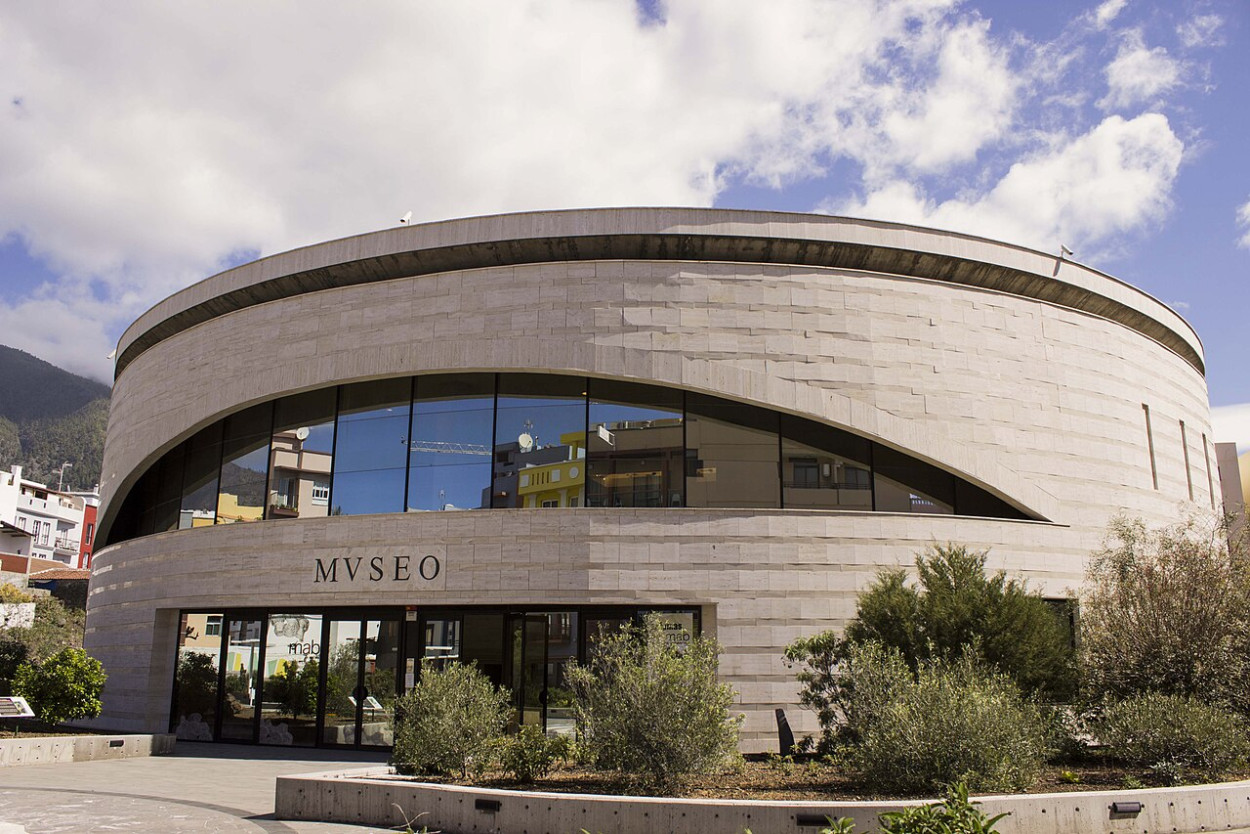
The MAB in the center of Los Llanos de Aridane conveys how the Benahoarites lived on La Palma before the Castilian conquest. Reconstructions, archaeological finds, and illustrative displays address housing forms, diet, crafts, livestock farming, rock carvings, and religious beliefs of the indigenous people. Address: Calle Las Adelfas 3, Los Llanos de Aridane
La Zarza in Garafía is one of the most significant rock art sites on La Palma. Spirals, circles, meanders, and lines appear on 29 panels. A small site museum introduces the pre-Hispanic culture; afterwards, a circular path through the forest leads to the original petroglyphs of La Zarza and La Zarcita. Access is located on the LP-1 at La Mata and Llano Negro in Garafía. Due to forest paths, weather, and possible operational changes, visitors should check opening hours and path conditions in advance.
In Belmaco, the first documented rock engravings in the Canary Islands were discovered in the 18th century. Ten natural caves and a site with petroglyphs form the archaeological complex. The visitor center explains the site with models, photographs, and multimedia content; a circular path connects the exhibition and the caves. The park is located on the road from Hoyo de Mazo to Fuencaliente, kilometer 7, Lomo Oscuro. The outdoor path may be restricted in unfavorable weather.
In an old windmill in Monte Pueblo, a special ceramic workshop was established. Ramón Barreto Leal and Carmen Cabrera Medina developed replicas of Benahoarite vessels in collaboration with archaeologists, whose shapes and engraved patterns are based on original finds. The exhibition, workshop, and the historic mill building together tell the story of this craft. El Molino is located at Calle Monte de Pueblo 30 in Villa de Mazo. Since it is a family-run workshop visit, prior confirmation is recommended.
The island museum is located in the former Franciscan monastery at Plaza de San Francisco. Its collections range from Flemish art and Canarian painting to ceramics, embroidery, silk, and natural history exhibits. Temporary exhibitions complement the permanently displayed collections and make the house a central cultural venue on the island. Address: Plaza de San Francisco 3, Santa Cruz de La Palma. The Cabildo publishes current opening hours and special exhibitions; the museum is usually closed on Sundays and holidays.
Casa Vandewalle at Calle Virgen de la Luz 13 was opened as the Museum of Contemporary Art and showcased Canarian art in a reconstructed historic house. The same building also housed the interactive Interpretation Center of La Bajada, which explains the Danza de los Enanos, the Minué, and other parts of the five-year festival tradition. The use and program of the municipal house have changed several times in recent years. It continues to serve cultural exhibitions and events; whether a permanent exhibition is accessible should be checked with the town hall before visiting.
At Plaza de la Alameda stands the Barco de la Virgen, a prominent replica of a 15th-century caravel. Inside, the municipal maritime museum displays models, nautical charts, documents, and historical objects related to the significance of La Palma for Atlantic navigation and shipbuilding in Santa Cruz. The decks can also be visited. Address: Plaza de la Alameda, Santa Cruz de La Palma. The museum currently states Monday to Friday 10:00 AM to 6:00 PM and Saturday and Sunday 10:00 AM to 2:00 PM. Phone: +34 922 411 787.
The Silk Museum-Workshop allows you to trace the entire traditional production process: from the breeding of silkworms to the reeling and dyeing, and finally to weaving on historical looms. Las Hilanderas preserves this completely handmade process and combines museum, living workshop, and sale of its own silk works. The museum is located at Calle Manuel Taño 4 in El Paso.
The Cigar Museum in San Pedro tells the story of tobacco cultivation, drying, leaf selection, and rolling Puros Palmeros. Tools, photographs, and demonstrations illustrate how closely this craft is linked to the island's emigration and economic history. The museum also offers cigars from local manufacturers. It is located in Parque de Los Álamos in San Pedro, Breña Alta.
The Wine Museum takes you through five centuries of Palmerian viticulture. Panels and historical tools explain growing areas, grape varieties, annual work, and pressing; in the garden, there is an old lagar made of Canary pine, a water reservoir, and typical vines. Tasting and selling local wines complement the visit. The house is located at Camino El Callejón 98 near the Plaza de la Glorieta designed by Luis Morera in Las Manchas de Abajo. It is situated south of the lava fields of Tajogaite and is accessible again; due to possible construction or access work, the opening should be confirmed in advance.
The stately Casa Roja from the early 20th century combines the embroidery museum and the documentation center of Corpus Christi. Exhibited costumes, ecclesiastical textiles, photographs, and designs showcase Palmerian embroidery as well as the ephemeral arches and carpets made from plants, seeds, and flowers that adorn Villa de Mazo for the Corpus Christi festival. Address: Calle Maximiliano Pérez Díaz 23, Villa de Mazo. According to current municipal information, the museum opens Monday to Saturday from 10:00 AM to 2:00 PM and also serves as a venue for exhibitions and cultural events.
The Museo del Plátano is dedicated to a cash crop that has significantly shaped the landscape and economy of the Aridane Valley since the late 19th century. Photos, tools, and documents explain varieties, irrigation, care, harvesting, packaging, and marketing of the Canary banana as well as the lives of the people in the plantations. The museum is located in the historic district of El Charco in Tazacorte, surrounded by traditional houses and banana fields. Since municipal opening hours may vary, it is advisable to confirm with the tourist information.
The Gofio Interpretation Museum is located in the restored windmill of Las Tricias, which operated until 1953. Inside, the mechanics and operation of the mill as well as the production of roasted grain flour, a staple food of the Canaries since pre-Hispanic times, are explained. Address: Calle El Polvillo, 38788 Las Tricias, Garafía. The municipality publishes current times and rates; Phone: +34 922 400 277 or +34 695 350 395.
El Regente is a water mill built in 1873 above Los Sauces. The restored building preserves the turbine room, milling equipment, kitchen with wood stove, and other elements of rural daily life. Thus, it is not only a Gofio museum but also a small ethnographic center about water management, nutrition, and traditional work. Address: Calle Los Molinos 33, San Andrés y Sauces. Visits and opening should be inquired directly with the municipality.
In the Casa de la Cultura of Santo Domingo in Garafía, an ethnographic interpretation center shows how people in the northwest of the island lived and worked in the past. Photographs, models, and interactive media illuminate agriculture, livestock farming, crafts, clothing, and festivals.
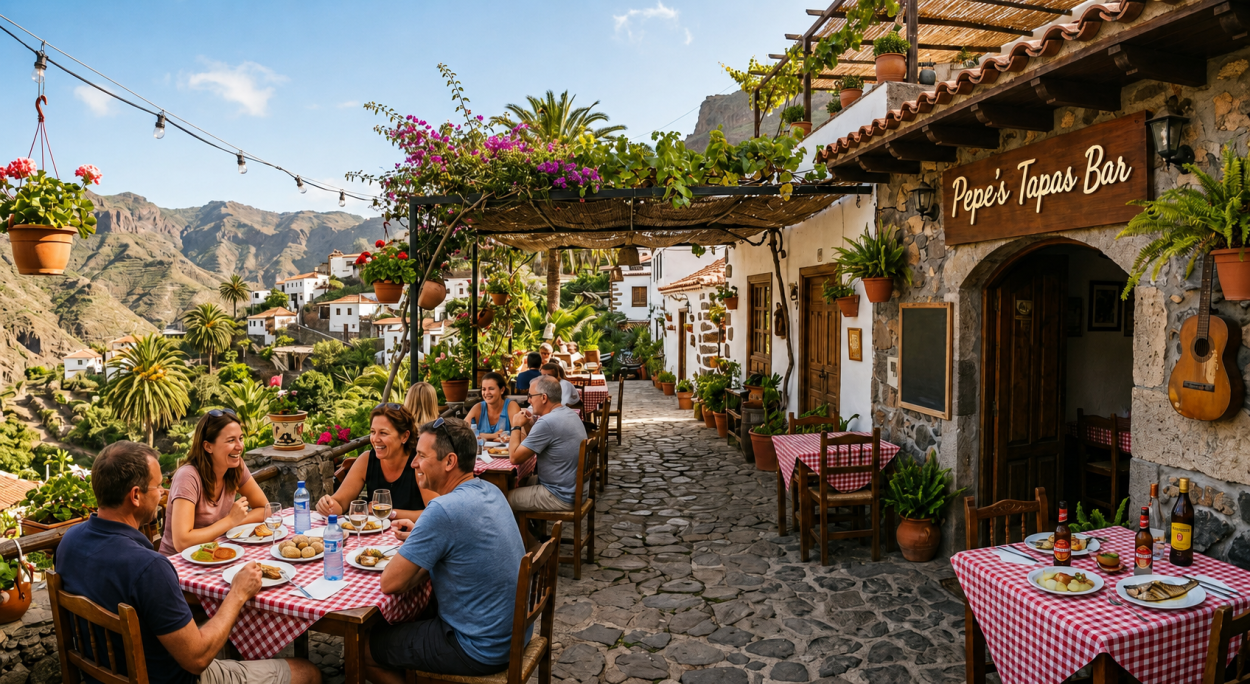
Whether it's Canarian home cooking, fish by the sea, or an evening at the tapas bar: There is much to try in La Palma. Here you will find a selection of restaurants that can serve as a starting point for your own discoveries. If you have a special tip, we would be happy to hear it.
Opening hours and rest days may change. Please check them directly with the restaurant before your visit; on weekends and holidays, a reservation is recommended.
Grill restaurant with international cuisine
Ctra. General Tajuya 49, 38750 El Paso
Tel.: +34 622 09 89 90
Opening hours: Wednesday: 16:30 – 21:30, Thu – Sun: 13:30 – 16:30, 17:30 – 21:30
Closed on Monday and Tuesday
Canarian and international cuisine
Urbanizacion Celta 1, 38750 El Paso
Tel: 0034 922 40 26 18
Opening hours: Fri – Tue 13:00 – 22:00
Closed on Wednesday and Thursday
International cuisine
Ctra. General Empalme Dos Pinos 57 (Celta), 38750 El Paso
Tel: 0034 922 40 23 05
Opening hours: Thu + Fri 18:00 – 22:00, Sat 14:00 – 22:00, Sun 14:00 – 21:00
Closed on Monday and Tuesday
Italian cuisine
Camino Pino Santiago 40, 38750 El Paso
Tel: 0034 922 46 24 03
Opening hours: Tue – Sat 13:00 – 16:00
Closed on Sunday and Monday
Canarian cuisine, grilled dishes
Cam. Cantadores 2, 38750 El Paso
Tel: 0034 922 40 21 95
Opening hours: Wed – Sat 12:00 – 23:00, Sun 12:00 – 21:00
Closed on Monday and Tuesday
International and Italian cuisine
Ctra. General Tajuya 2, 38750 El Paso
Tel: 0034 922 48 55 06
Opening hours: Fri – Tue 13:00 – 18:00
Closed on Wednesday
Simple restaurant with Canarian cuisine
Ctra. General Dos Pinos, 38750 El Paso
Opening hours: Mon – Sun 6:00 – 23:00
Italian cuisine, pizza
Calle Fernandez Taño 56, 38760 Los Llanos
Tel: 0034 922 40 26 48
Opening hours: Thu – Mon 13:00 - 16:00 and 19:30 – 23:30, Tuesday 13:00 – 16:00
Closed on Wednesday
International cuisine, fish specialties, burgers
Plaza de España 3, 38760 Los Llanos
Tel: 0034 822 61 40 14
Opening hours: Mon + Thu 13:30 – 17:00 and 19:00 – 22:00, Fri + Sat 13:30 – 17:00 and 19:00 – 23:00, Sun 13:30 – 16:30
Closed on Tuesday
Argentinian cuisine, grilled dishes
Calle Fernandez Taño 29 A, 38760 Los Llanos
Tel: 0034 695 36 88 74
Opening hours: Thu – Sat + Mon 13:30 – 16:00 and 19:30 – 22:00, Wed 19:00 – 22:00, Sun 13:30 – 16:00
Closed on Tuesday
Fish specialties
El Remo s/n, Los Llanos de Aridane
Tel: 0034 654 14 16 27
Opening hours: Mon – Fri 13:00 – 21:00
Closed on Saturday and Sunday
Canarian cuisine
Plaza Castilla 1, 38770 Puerto de Tazacorte
Tel: 0034 822 29 77 60
Opening hours: Fri – Wed 13:00 to 22:00
Closed on Thursday
Canarian cuisine
Paseo de los Beatos Mártires de Tazacorte s/n, 38779 Tazacorte
Tel: 0034 922 40 61 36
Opening hours: Wed – Mon 11:00 – 23:00
Closed on Tuesday
Canarian cuisine, fish specialties
Av. El Emigrante s/n, 38770 Puerto de Tazacorte
Tel: 0034 922 48 05 33
Opening hours: Fri - Tue 12:30 – 22:30
Closed on Wednesday and Thursday
Canarian and Spanish cuisine
C. Los Volcanes 23, 38740 Fuencaliente
Tel: 0034 922 44 44 27
Opening hours: Tue - Sat 13:00 – 17:00
Closed on Sun + Mon

Some places particularly impressively show how diverse La Palma is – from the caldera and the volcanoes to the old town of Santa Cruz. Allow some time for the destinations in the mountains and check the weather, access routes, and possible reservations before setting off.
The national park in the heart of La Palma impresses with steep rock walls, pine forests, and deeply carved valleys. Even the view from the viewpoint La Cumbrecita gives an impression of its size.
If you want to hike into the Caldera, choose a route that suits your fitness level, and check the weather, trail conditions, and access beforehand. Great panoramas can also be enjoyed from the viewpoints at the edge.
The Roque de los Muchachos is the highest point of La Palma at around 2,426 meters. On a clear day, the view extends over the Caldera and to the neighboring islands.
On the ridge is the Observatorio del Roque de los Muchachos with the Gran Telescopio Canarias. If you want to see the observatories from the inside, you should check in advance about tours and reservations. Even without a guided tour, a trip on a clear day is worthwhile – remember to bring warm clothing.
The island's capital invites you to stroll with its cobblestone streets, historic facades, and famous wooden balconies. The town hall and the church El Salvador are located on the Plaza de España.
In Calle O’Daly, you will find shops, cafés, and local specialties. Take your time to explore the alleys and enjoy the view of the city from the sea.
The iron-rich deposits color the rock face at the waterfall in shades of red, orange, and ochre. The Cascada is located in the area of the Caldera de Taburiente and can only be reached by a longer hike.
Check the current trail conditions and water levels before planning your tour.
The Volcano Route leads over the Cumbre Vieja through pine forests and barren volcanic landscapes to the south of the island. Along the way, wide views alternate with impressive lava fields.
The long route with significant elevation changes is aimed at experienced hikers. Pay attention to the current information on trail conditions, weather, and return transport.
Under a massive rock overhang on the west coast stand the whitewashed houses of the small cove, which is also called "Smuggler's Cove." The place near Tijarafe offers an unusual view of the coastal landscape.
The access road and footpath to the cove are steep. Check the conditions before your trip and stay away from the water during high waves.
The sheltered cove on the east coast combines black sand with good opportunities for swimming, snorkeling, and diving. Underwater, there are volcanic rock formations to discover.
Also, pay attention to the beach flags and the current conditions in the water. Restaurants and cafés are nearby.
At the southern tip of the island, the white salt pans create a strong contrast to the black lava and blue sea. During a walk, you can see the traditional salt extraction up close.
Nearby are the lighthouses of Fuencaliente. The visit can be easily combined with a detour to the coast.